
Panel Discussion on Combating the Global Backlash Against Women
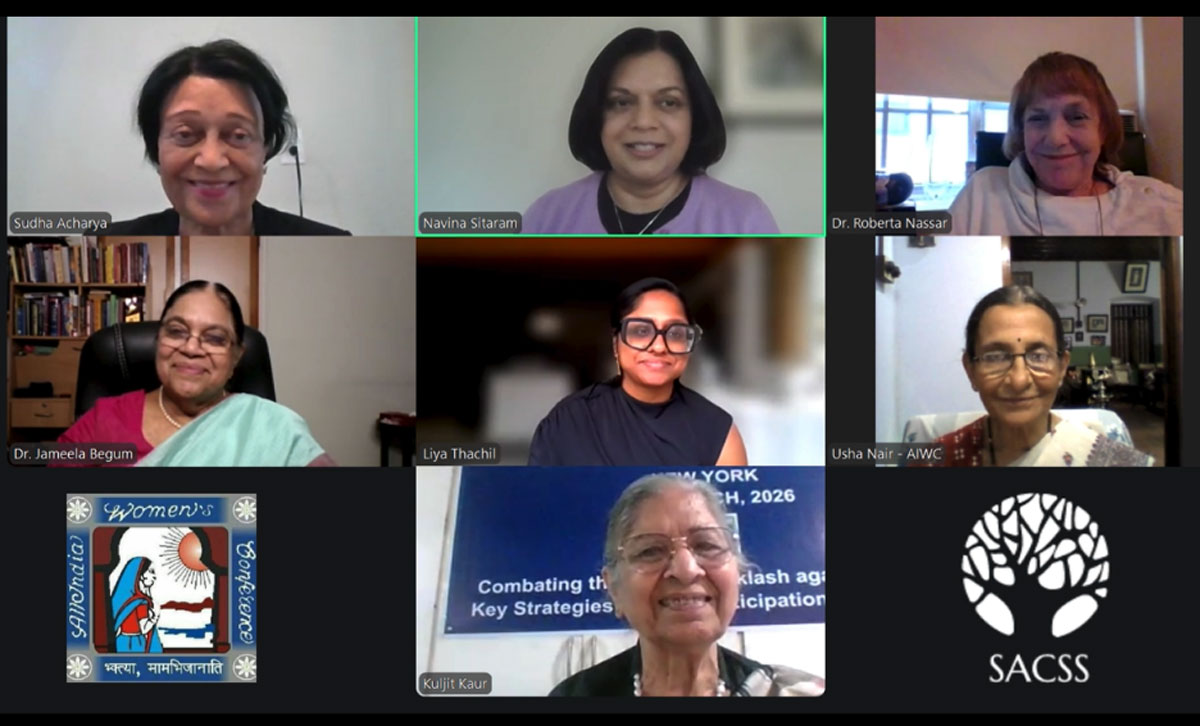
This Women’s History Month, the All India Women’s Conference (AIWC), the NGO Committee on Human Rights and SACSS came together to host a panel discussion on “Combating the Global Backlash Against Women: Key Strategies for Full Participation in Public Life.” Navina Sitaram, Representative to the United Nations for AIWC, moderated the session.
Watch the panel discussion here:
Sudha Acharya, Executive Director of SACSS and Principal Representative to the United Nations for AIWC, opened the discussion by highlighting growing global concerns around gender equality. In early 2025, UN Women reported that 24 percent of countries are experiencing a significant backlash, slowing progress and limiting women’s participation in public life, especially in leadership roles. She encouraged the panel to share both lived experiences and practical strategies to push back against these trends.
Key strategies:
Dr. Roberta Nassar, Chair of the NGO Committee on Human Rights in New York, spoke about the importance of working together across organizations and communities. She emphasized the need to understand systems of power and funding, strengthen grassroots advocacy and stay alert to efforts that weaken women’s rights at the global level.
Kuljit Kaur, President of AIWC, reflected on both progress and ongoing challenges. While progress has occurred in education and legal rights, many women still face violence, economic barriers and underrepresentation. She stressed the need for stronger enforcement of laws, shifts in social attitudes, and greater involvement of men as allies.
Prof. (Dr.) Jameela Begum from AIWC Trivandrum spoke about the gap between education and opportunity, noting that access to education does not always lead to employment due to structural barriers. She highlighted the importance of community-driven models like Kudumbashree in building women’s leadership and economic independence.
Liya Thachil, Executive Director of the New York State APA Task Force, focused on the role of state-level advocacy in supporting marginalized communities, particularly women of color. She spoke about the importance of building relationships, increasing visibility, and encouraging civic participation to ensure policies reflect real community needs.
After the panel discussion, the audience actively engaged, raising thoughtful and pressing questions. One question focused on whether UN Women and UNFPA could jointly oppose a proposed merger that may weaken their effectiveness and whether such discussions should wait until broader reforms prioritize the safety and security of women and children. Panelist Dr. Roberta Nassar addressed this concern, agreeing with the risks of consolidation and the potential impact on maintaining focus on women’s issues.
Another question from the audience asked panelists to identify key steps to increase women’s participation in public life. The panelists proposed multiple suggestions, such as supporting women candidates through mentorship and community coalitions, encouraging shared caregiving responsibilities, starting conversations about gender equality at home, increasing women’s representation in leadership roles and building stronger networks that include men as allies.
Usha Nair from the All India Women’s Conference delivered the closing remarks, bringing together the key themes from a diverse discussion while acknowledging the challenge of summarizing such a rich conversation. She closed with a hopeful message from a UN Women report, noting that this could be the first generation to live in an equal world, and urged women to stay united and continue pushing for progress despite global conflicts, climate challenges, and ongoing backlash.
Across all perspectives, one message remained clear: progress requires continued collaboration, reflected in the panel itself with women in leadership positions from South Asia and the United States, along with stronger community engagement and sustained investment in women’s leadership.